
Read the Ness County Owner Record
Start with the Ness County Treasurer search. Its "Current Owner" radio option sits beside Taxpayer and Both. The Appraiser parcel card stays out of reach online. That means its exact owner label and deed-reference field remain unknown here. Treat the fields below as verified search inputs. Confirm any returned details against the recorded deed itself.
| Current Owner | Verified name-role control in the public tax search |
|---|---|
| Taxpayer | A separate role that may identify the party responsible for tax notices |
| Property Address | Street Number and Street Name search inputs for the physical parcel |
| CAMA Number | Grouped local account components used to keep the match tied to one parcel |
| Legal Description | Subdivision, block and lot, or section, township and range |
| Latest Deed | Recording date, grantee, land description, and vesting to verify at ROD |
The owner of record is not always the occupant. The taxpayer is not always the title holder, either. A situs address shows where the land sits, while a mailing address only routes notices. Ness County verifies the role choices on its form. But no sample result shows the parcel-card layout. Check every label a search returns rather than assuming a standard format.
Use Ness County Current Owner
Open the Treasurer tax search and select Real Estate for an ordinary parcel. Enter the Street Number and Street Name, or use the exact legal-description fields instead. For a name search, choose Current Owner first. Switch to Taxpayer or Both only when the role seems unclear. Separate same-name hits by parcel address and legal description.
The form also accepts Owner / Taxpayer Identification and Tax Identification. Its CAMA Number breaks into MAP, SEC, SHT, QTR, BLK, PRE, SUF, and OWN. Keep any leading zeros intact. Ness County publishes no example that converts this local key into another APN format. So do not attempt the translation on your own.
Date the Ness County Owner Check
The Treasurer database displays a July 24, 2026 update date. The Appraiser portal entry reads September 2, 2026 at 4:01 p.m. These timestamps describe database refreshes. They do not guarantee that every new conveyance has landed in each system. Ness County publishes no fixed deed-to-roll lag. A freshly recorded deed can still trail behind both databases by days or weeks.
Note the date of your lookup plus the refresh marker the portal displays. For a recent closing, compare the deed's recording date with the database date. Then call the office that keeps the account. That small audit trail explains why two accurate sources may briefly show different owner names.
Fresh sale rule. A Ness County roll may trail a new conveyance. The newest recorded deed is the more current ownership source.
Confirm the Current Ness County Owner
Both records prove ownership in different ways. The tax roll carries the administrative name tied to the account. A deed goes further at the Register of Deeds, where each instrument is checked for recordability, assigned a book and page, imaged, and indexed. Match the land, never just the party name.
- Find the parcel in the tax search with address, Current Owner, or legal-description fields. Copy its local identifiers and full description.
- Search the CIC deed index with the exact name and description. Look for the newest recorded conveyance that covers the same tract.
- Read the grantee and vesting language on the instrument. Check that subdivision, block and lot, or section, township and range agree.
- If the roll and deed differ, compare dates and contact the Register of Deeds or Appraiser rather than choosing the result that looks newer.
- Owner of record
- The party named as owner in the particular official roll being checked.
- Assessment roll
- The administrative parcel and value record used for property assessment.
- Situs address
- The physical parcel address, which may differ from the mailing address.
- Recording lag
- The interval before a new recorded transfer reaches another county database.
Most recordable documents are completed and returned within two to four business days, per the county. No such promise covers the tax-roll update. Anything received after 4 p.m. is recorded on the next business day instead.
Check Ness Appraiser Portal Limits
The Ness County Appraiser Parcel Information portal offers registered-user login plus public access. It serves as the county route for parcel and valuation detail. The public card does not render, though. Its current-owner field, owner history, sale history, image tab, and export controls therefore remain unknown. Call the Appraiser office to learn exactly what the live card displays. Staff can also explain more. They can describe how a recently recorded deed reaches that card. Kelly DesLauriers, RMA, is the county Appraiser. The office sits in Suite 12 at the courthouse. Reach it at 785-798-2777.
The official Ness County parcel portal posts the access point and update notice used for a current owner check. Any parcel-number search starts there.
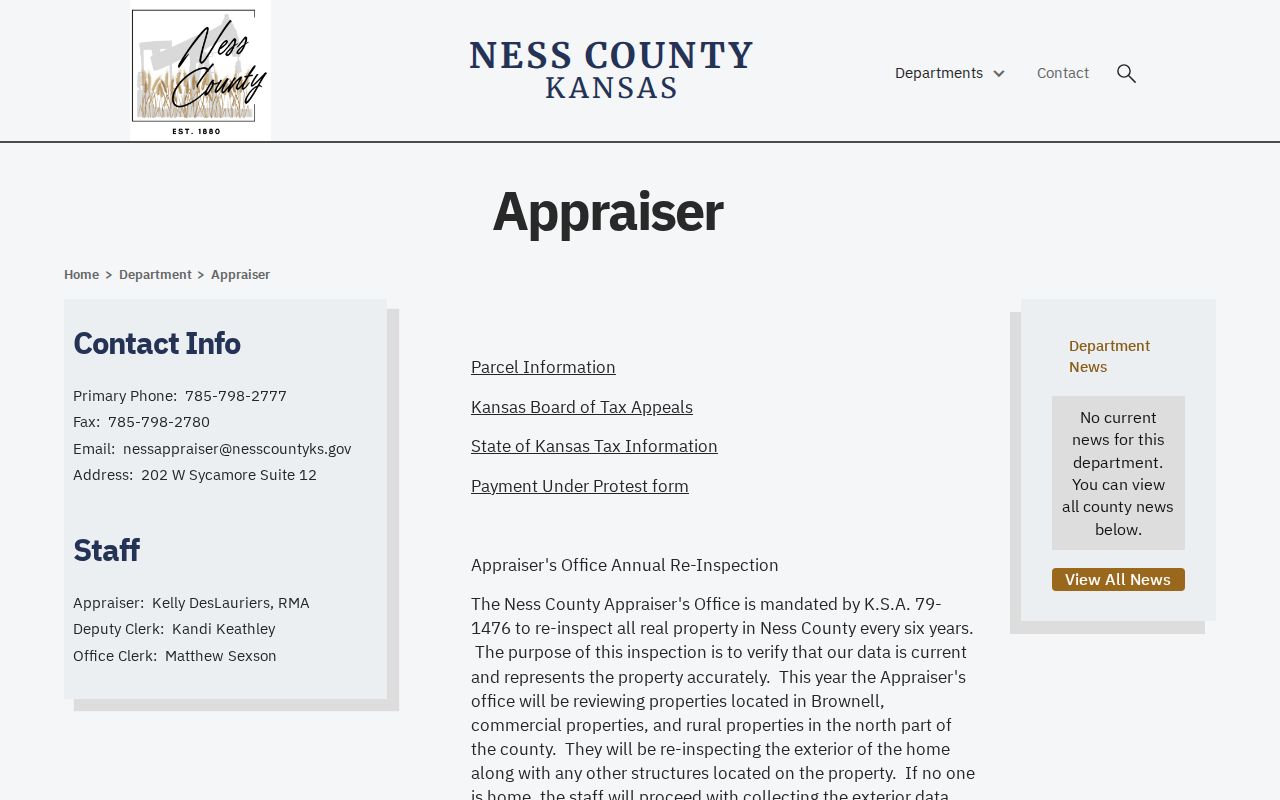
The official appraiser portal page shows its own date limits and public-access notes.
Verify Ness County Entity Names
An LLC or corporation can hold title. So copy the full grantee name exactly as recorded, suffix and all. Miss one letter and the match fails. The Kansas Secretary of State search takes a business name, a Kansas SOS Business ID, or a resident-agent name. Name matching offers Contains and Starts With modes. The tool caps results at 200 entries. That is plenty for most Ness County parcel lookups.
Remember what the entity record proves. It confirms the business exists and stands in good standing. It does not prove the company owns the parcel. A registered agent, likewise, is not presumed to hold the land. Sole proprietorships and DBAs may never reach the Secretary of State at all. So the Ness County deed and its land description remain the controlling record for the owner of record.
Read Ness County Trust Owners
Trusts and estates show up often in Ness County property records. A deed may name a trustee, an estate, or a personal representative. Keep the full capacity wording exactly as recorded. Shortening a trustee to an individual owner distorts the record. An estate representative is not the beneficiary, either. When death drove the transfer, a certified death certificate may sit in the land records. Kansas eligibility rules still govern access to vital records.
Probate, quiet-title, foreclosure, partition, and judgment matters can pull in the Kansas court portal. They may also involve the local District Court clerk. The recorded deed still controls the land record. Court files may explain who holds authority. They never justify rewriting the grantee language on the instrument.
Read the Latest Ness Deed
The Register of Deeds reports documents reaching back to 1988. Those records are searchable by name or legal description. Search help accepts one-part names, Last First, First Last, and quoted exact phrases. It also warns that names can be misspelled and that an index can omit documents. Post-2023 records respond best to a legal description search with Find Now. Index images were scanned only through 2023.
These coverage rules shape any owner-of-record check. Run the legal description even after a name search looks complete. A remote index or image cannot always settle the newest vesting. The physical office is the fallback then. For the wider route, see who owns a Ness County property.
Note: A portal index hit points to an instrument; reading the recorded deed is what confirms its grantee and land.
Use Ness County Owner Data Lawfully
A current owner name answers a parcel task. It can verify a seller. It can settle a boundary question. It can support a property-specific letter, or inform an estate check. It does not reveal every occupant. Nor does it license collecting unrelated personal details. A mailing address is an administrative contact and may not be a residence.
Kansas Safe at Home can place a substitute legal address across covered records. Covered records span city, county, voter, court, and law-enforcement files. Never try to reverse that safeguard through GIS or any other database. Kansas law also restricts some commercial use of public name-and-address lists. Keep only the fields the land question requires. Confirm any legal action with the proper custodian or a professional.
Lawful use. Contact a Ness County owner only for a legitimate property matter. Using public records to stalk, harass, intimidate, or harm anyone is prohibited.