
Compare Ness County Property Values
Name the figure before comparing anything. Kansas starts with appraised, or market, value as the full-value estimate for a parcel. A class-specific assessment level then converts that estimate into assessed value for the tax roll. A recorded deed can add a third data point. But a transfer price is neither of the two tax values.
| Value type | Meaning | Official record |
|---|---|---|
| Appraised or market value | County estimate of full value for assessment purposes | Appraiser parcel and valuation record |
| Assessed value | Appraised value multiplied by the Kansas assessment level | Appraiser and tax record |
| Last sale or consideration | Evidence of what changed hands in a recorded transfer, when available | Recorded instrument or possible sale-history file |
Residential real property carries an 11.5% assessment level. So treat a home's market estimate and its assessed value as two different figures. Do not read them as two versions of one price. Agricultural land follows a use and productivity method of its own. Other classes have their own levels. Whatever the class, note it beside any Ness County property value, along with the year and the source.
Ness Residential Assessment Math
The formula separates value from tax. The Kansas Department of Revenue formula lays out each step. Appraised value times the assessment level gives assessed value. That assessed figure times the mill levy, divided by 1,000, produces the property tax calculation. The first two numbers describe valuation, while the final charge belongs on the tax bill.
Run a quick example. A residential appraised value of $100,000 at 11.5% yields an assessed value of $11,500. The math shows the ratio only. It is no estimate for a specific Ness parcel. It leaves out any particular levy or exemption.
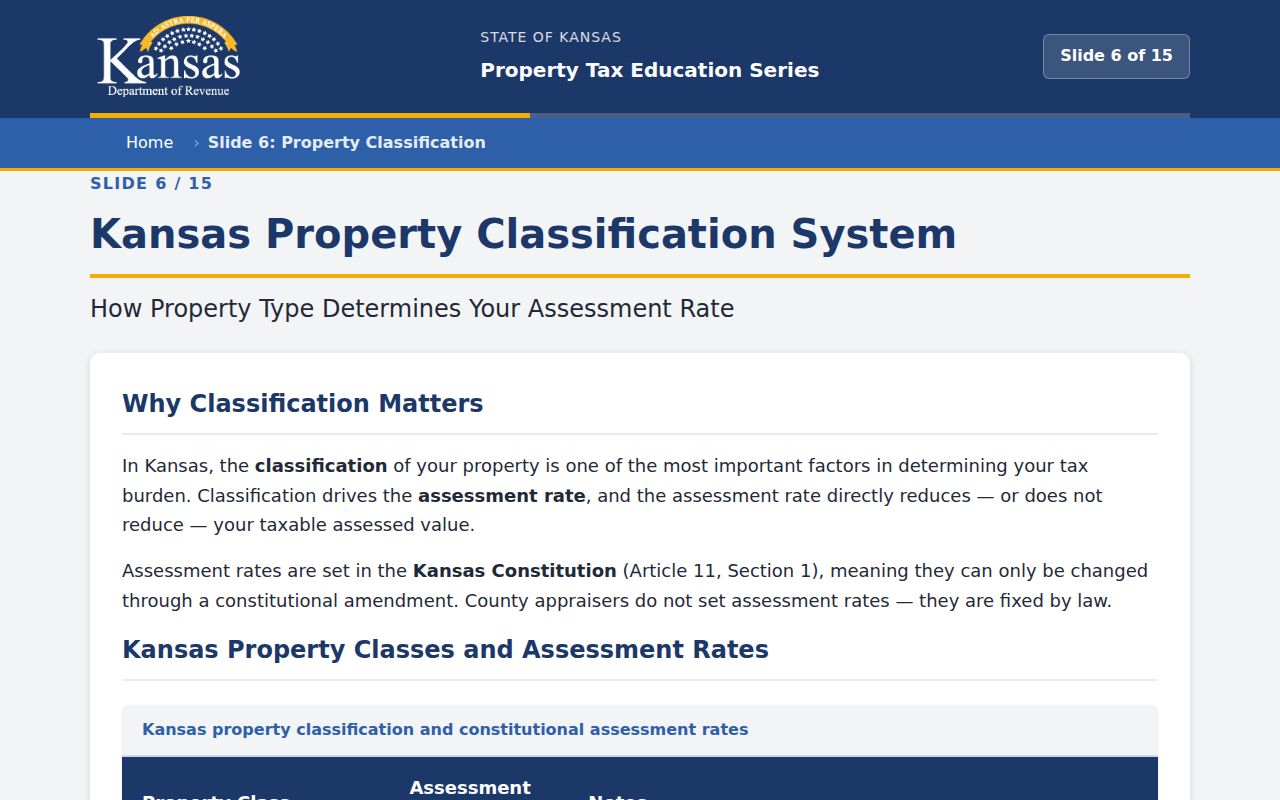
The state formula image shows why a tax account's assessed value sits below its appraised figure. Valuation years matter too. Use the year the county displays, because a later market study or a data correction can shift the next record.
Find a Ness County Property Value
The Ness County Parcel Information portal offers a public-access button and posts a database update timestamp. The sample parcel card does not display. So the field labels for market value, assessed value, owner of record, or sale history are not fixed. Match the parcel number first.
The official Appraiser page names the office.
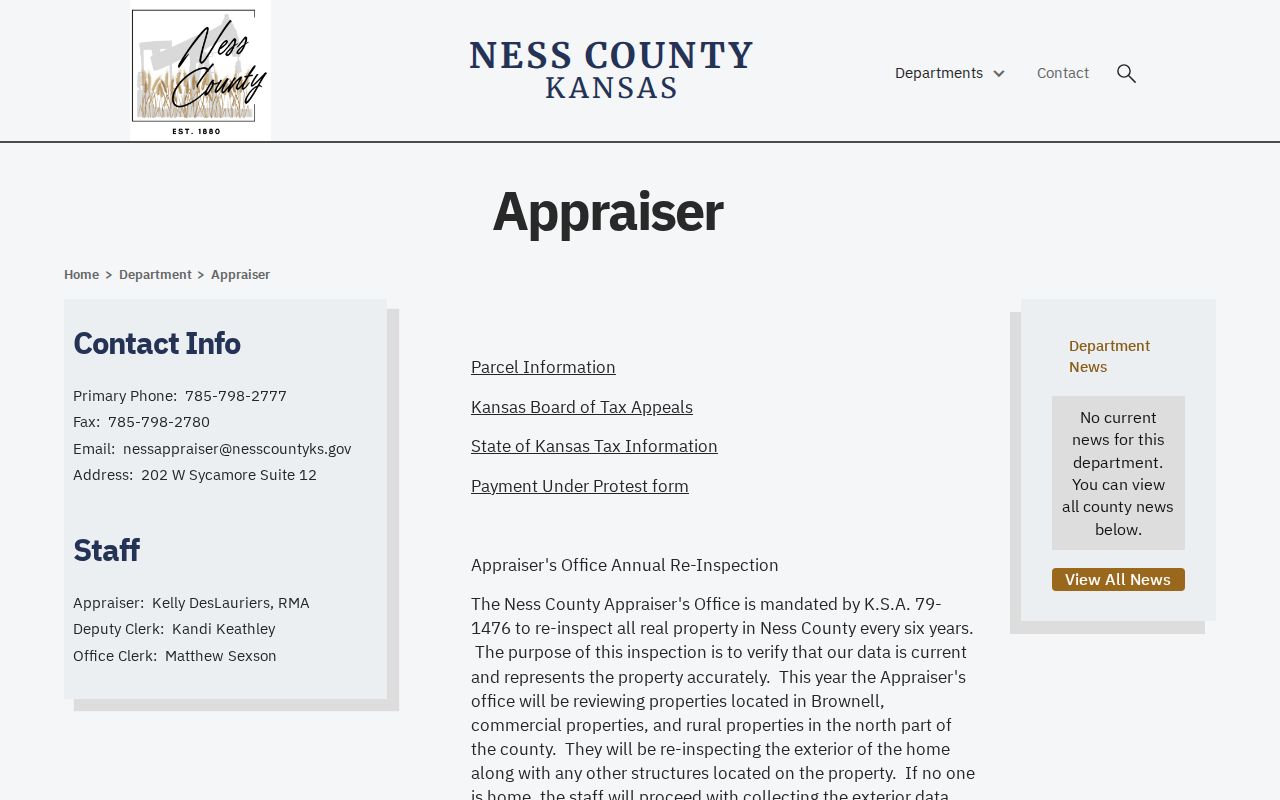
When a portal result needs context, the office source settles questions of class, year, and valuation wording. That is where the record lives.
- Open public access and find the parcel by the available address, owner, or account route. Confirm the Ness County legal description.
- Record the valuation year, property class, appraised or market figure, and assessed figure exactly as displayed.
- Apply the Kansas class level only as a cross-check. Ask the Appraiser when a label or classification is unclear.
- For sale evidence, inspect the recorded deed or ask whether an assessor sale-history file is available for that parcel.
- Appraised value
- The county's mass-appraisal estimate of market value for its valuation work.
- Assessed value
- The appraised value after the statutory assessment level is applied.
- Assessment level
- The class-specific percentage used to convert appraised value to assessed value.
- Consideration
- The value exchanged in a transfer as stated or supported by the recorded material, when public and available.
- Reinspection
- A review of physical property data, not an automatic reset of every value.
Ness Property Class Changes Math
The state lists distinct assessment levels. Residential real property is 11.5%. Vacant lots and nonprofit real property are 12%. Commercial and industrial real property and agricultural improvements are generally 25%. Agricultural land and other property are listed at 30%, while public utility property is 33%.
Class is not a detail to skip. A house, vacant lot, commercial site, agricultural land, and farm improvement may convert from appraised to assessed value at different rates. Confirm the specific account's classification with the Ness County Appraiser before drawing a comparison.
Note: Compare like classes and the same valuation year when using nearby parcels as context for a Ness County property value.
Ness Agricultural Value Works Differently
A farm's value does not come from home sales. Kansas measures farmland by use and productivity instead. Neighboring house prices barely enter the math. With a 30% assessment level on top, a farm's assessed figure cannot sit beside a residence's assessed value without adjusting for class. Improvements on the land generally fall in yet another class.
The method is state-built. The county sets agricultural values through Kansas Department of Revenue and Kansas State University methodology, with figures open for review at the Appraiser office. Rural north Ness County joined 2026 inspection work. That review may update physical facts. All land values did not move alike.
Ness County's 2026 Value Signals
The county's 2026 market study described the overall residential direction as inflationary. Commercial and industrial property was stable. Vacant property was stable too. Those are broad market-study directions rather than predictions for any single parcel. A property can still move its own way through physical changes, corrections, or the comparable sales behind it.
Owners got the estimate by March 1, 2026. The county describes a 30-day appeal period from mailing. Those dates explain when the figure arrived. The appeal process itself belongs with Ness County property tax records rather than with the meaning of value.
Ness Reinspection Updates Property Facts
K.S.A. 79-1476 calls for reinspection every six years, per the county Appraiser page. Staff check exterior facts about homes and structures. They may leave a door hanger when nobody answers. Named 2026 review areas included Brownell, commercial properties, and rural north county.
Reinspection verifies data. It is not a promise that every parcel gets the same new Ness County property value on a six-year schedule. One record may change from a corrected structure size, a new improvement, a removed building, a class change, or a different set of comparable sales. Another may not move at all.
Find Ness Sale-Price Evidence
A public Appraiser card does not always show a last sale price. Appraised value, assessed value, class, sale date, and consideration may not sit together on one screen. The county Register of Deeds page links a Sales Valuation Questionnaire. Its exact form fields vary. Consideration or transfer details usually live inside the recorded instrument itself.
The Appraiser may keep a sale-history file. It costs nothing to ask. The recorder index can lead you to the deed by party name or legal description. Read the actual instrument. An index entry alone cannot tell you whether a transaction was arm's length, partial-interest, family-related, or otherwise unlike an open-market sale.
Compare Ness Values by Date
Every value comparison needs an effective date. The Appraiser portal stamps its database with a system timestamp, but that only signals freshness. It is not the legal effective date of each value. It does not promise that every parcel field changed that day.
Keep the record year next to the figure. Then note the property class. Also note the nature of the number. Check whether it is the county's appraised value, the statutory assessed value, or a transfer amount. A current asking price and a private appraisal belong in separate columns. That keeps market signals from being mistaken for official assessment data.
When Ness Value Records Differ
Verify parcel identity first. Similar owner names, replats, and split tracts are common culprits. So is a careless address abbreviation, which can produce a wrong match. Next, compare years and classes. Then ask the Appraiser about the parcel record. Lean on the recorded instrument for transfer evidence.
The Ness County Appraiser sits at 202 W Sycamore, Suite 12, Ness City. The office is reachable at 785-798-2777 and nessappraiser@nesscountyks.gov. It can explain its assessment record. For a present market opinion tied to a sale, a licensed appraiser is the right source. That holds for any other high-stakes decision, too.
Limits of Ness Property Value
An assessment belongs to a mass-appraisal and tax system. It does not inspect a home for a buyer. It promises no sale price, guarantees no condition, establishes no title, and settles no boundary. Even the county's appraised or market label carries a stated valuation purpose and date.
Recorded consideration is historical too. Its terms or interests may hide behind a single figure. Use the county record to identify what number was assigned or recorded, then choose a licensed appraisal or other professional review when the question is current market worth.
Value is not price. A Ness County assessed value supports taxation. It is not a sale forecast and does not replace a licensed appraisal.