
What Ness County Deeds Convey
The Ness County Register of Deeds records deeds and a wide family of related instruments. A deed's text states the interest it transfers and describes the land. The office also holds mortgages, liens, patents, plats, leases, and powers of attorney. All of these can shape the ownership trail. Always read the deed type alongside its actual terms.
| Deed Type | What It Does | Common Use |
|---|---|---|
| Warranty deed | Conveys the stated estate with covenants written in the deed. | An arms-length or other land transfer. |
| Quitclaim deed | Conveys the grantor's interest, if any, without the same covenants. | Family transfers or title cleanup. |
| Executor or trustee deed | Transfers under estate or trust authority stated in the paper. | Estate and trust administration. |
| Patent deed | Documents an early grant reflected in patent books. | Historic federal-to-private land trail. |
| Mineral or oil/gas instrument | Transfers or reserves a stated subsurface interest. | Separate mineral and lease research. |
A deed moves ownership. A mortgage or lien does not. Instead, it burdens an interest while the borrower owes money, and a release can lift that burden later. A document's label alone tells you little about title.
Ness Deed Index Coverage
Ness County describes its online deed records as present through 1988. They are indexed by legal description and name. That statement is careful. It does not name 1988 as the first year available. It does not promise that every image is free. The office itself holds physical records reaching back to the late 1800s. These distinctions matter. A web search can stop short of where the ownership trail actually ends.
The county also notes its indexes are scanned through 2023. For deed records after that year, search by legal description. Names in the index can be misspelled or left out. A recently signed deed may sit unrecorded, too, or await indexing and a tax-roll update. Trust the instrument's own recording data over any guess about portal refresh timing.
Coverage limit. Online wording reaches “to 1988,” while the late-1800s trail continues through the Register of Deeds office and its books.
Search Ness County Deed Fields
The county links the CIC land-record search and posts detailed search tips for it. Note one wrinkle. The remote subscription host the county lists is not the same as the public search host. So confirm the correct login route with staff before paying. Start broad, then narrow. Run a wide name or land search first. Then apply the most specific field you have verified.
| Index field | Accepted approach | Ness County caution |
|---|---|---|
| Date Recorded | Blank, same-day pair, or start/end range | Blank searches from November 2004 under the help text. |
| Party Name | One part, Last First, First Last, or quoted name | Try variants because spelling may be wrong. |
| Block/Lot | Letters such as Aa or numbers such as 123 | Pair with the exact subdivision. |
| Unplatted land | Section, Township, Range | Use the full legal description. |
| Index image | Subdivision or S/T/R plus folder | Post-2023 work needs legal description and Find Now. |
The official material lists no sample result, export option, or exact public image charge, so treat those details as unconfirmed until staff states them.
The CIC recorder landing page is the official remote index destination for Ness County deed records.
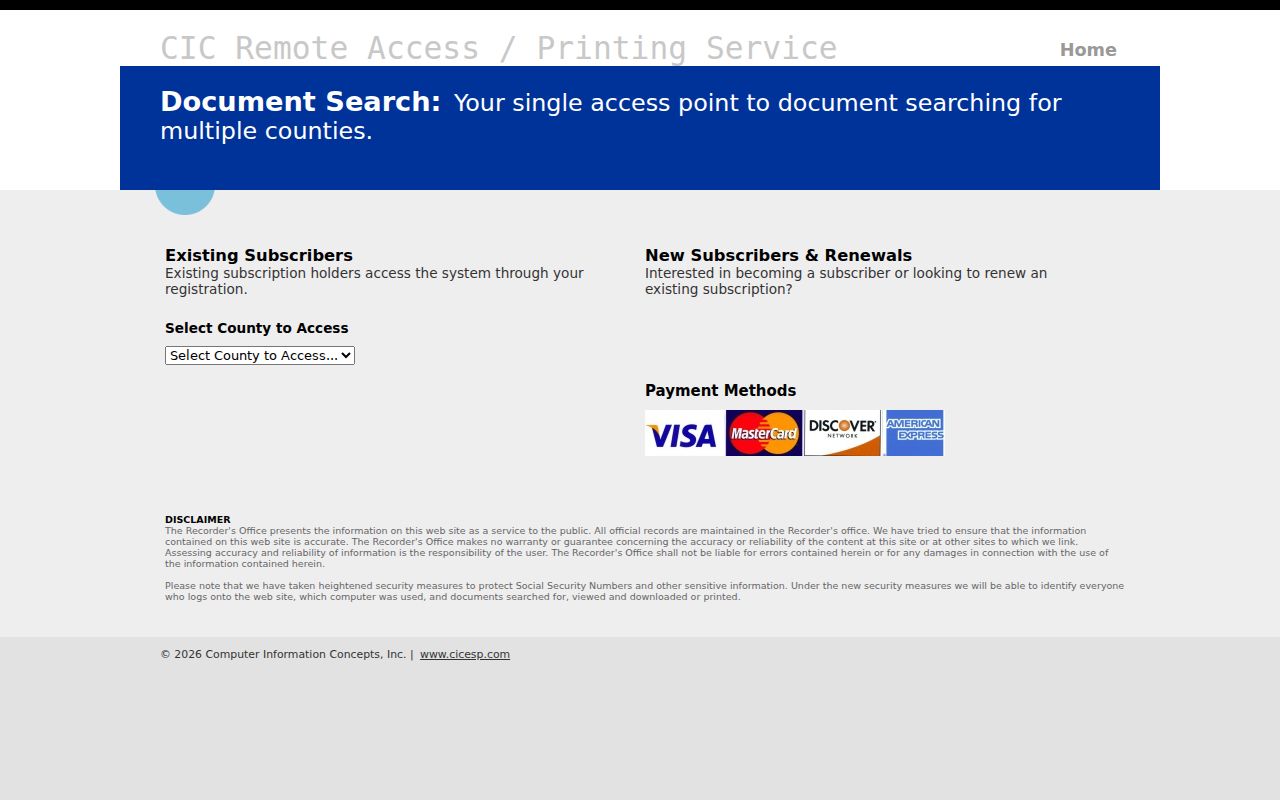
The search screen shows the route into the deed index itself. Coverage details and any county-specific wording still trace back to the Ness County Register of Deeds.
Follow Ness County Grantors and Grantees
Every Ness County deed names two parties. The grantor conveys the interest. The grantee takes it. Working through the grantor-grantee index lets you tie each conveyance to the one before it, as long as the legal description stays consistent from deed to deed. Watch for a replat, a split, or a reservation that branches the trail.
- Find the newest recorded transfer for the exact legal description and read the current grantee.
- Record the grantor, date, deed type, book and page or other instrument reference.
- Search that grantor as an earlier grantee, then compare the land description in both deeds.
- Repeat until the web trail ends, then continue through deed books, tract indexes, and plats at the office.
- Grantor
- The party that transfers the stated interest.
- Grantee
- The party that receives the stated interest.
- Chain of title
- The linked sequence of instruments affecting the same land.
- Book and page
- The office reference assigned to a recorded paper.
Decode Early Ness County Books
Early Ness County deed books carry local prefixes that act as search keys. Books 1 through 54 use D for deeds. MS covers miscellaneous. PT marks a patent. OG stands for oil and gas, OGR for an oil and gas release, and RA for release assignment. From book 55 onward, the book number alone covers deed and miscellaneous work. The codes are practical handles, not deed types.
Patent books are a special Ness County thread. The office notes that some patent deeds bear early presidents' signatures. Not every tract has one. A patent entry can still open an early chain of title. Its land description has to be tracked through the later deed records and plats.
Ness Deeds Meet the 1906 Atlas
The 1906 Geo. A. Ogle atlas pairs township maps with landowner names, town plats, portraits, and a patrons directory. It is a historical lead. It is not proof of current title. Set any atlas name and tract position beside the recorded deed chain before you draw a conclusion about ownership.
Old place names can sharpen the search. Ness City once carried the post-office name Iowa. Ransom was Ogdensburgh before its renaming. A name that drops out of a modern search may survive in an atlas, a newspaper notice, a probate file, or a deed index filed under the former place name. The Kansas Historical Society bibliography also flags local newspaper microfilm and clippings as a bridge when a party name proves hard to trace through Ness County deed records.
Record New Ness County Instruments
Recording a deed in Ness County starts with the register of deeds. The office checks each instrument for recordability and fees. It assigns a book and page, creates an image, indexes the paper, and sends the original back to the filer. To pass that review, a document must meet certain standards. Signatures need printed names beside them. The text must be legible. The notary seal and signature have to be visible on the page. Margins matter too: the first page requires a three-inch top margin. Later pages need one inch. A missing signature can get a deed rejected. A flawed notary acknowledgment, wrong margins, or unreadable print can too.
Timing is straightforward. Anything received after 4 p.m. is recorded the next business day. Most instruments come back completed within two to four business days. The register of deeds may accept a self-drafted deed. But it recommends an attorney, abstractor, or title company instead. The office will not offer an opinion on whether title is clear.
Ness County Deed Recording Costs
Ness County sets its recording fees by Kansas statute. It pays to confirm the current chart before filing. A deed, mortgage, or other general instrument runs $21 for the first page. Each added page or fraction is $17. A town plat is $32 per page. Material and service liens cost $17. A one-page mortgage release or assignment costs $20. Extra charges apply for added pages and additional book-and-page references.
Copies from the office are $1 per page. An emailed copy is $1 per document. Short-term remote plans run $25 for one day or $250 for one month. A 4.5 percent card fee and 50 cents per printed page also apply. Six-month and annual plans exist too. Call 785-798-3127 for an exact total on a long document with attachments or multiple references.
Ness Recording Alert Subscription
The Register of Deeds posts a Recording Alert Subscription form. The county uses that exact name. Confirm enrollment details with the office before relying on the service. An alert is a notice tool, not a guaranteed fraud block.
An alert will not stop a filing. It will not judge its legal effect. It also will not replace reading the instrument itself. If an unexpected notice arrives, request the indexed paper from the office and consult qualified counsel or a title professional.
Request a Ness County Deed Copy
The Register of Deeds sits at 202 W Sycamore Street, Suite 7, Ness City, KS 67560. Office hours are 8 a.m. to 5 p.m., the phone is 785-798-3127, and email is rod@nesscountyks.gov. When requesting a deed, supply the book-and-page or instrument reference, party names, recording date, and legal description. Also say whether a plain copy, emailed document, or certified copy is needed. Confirm the fee and delivery method before sending payment.
The counter, phone, email, and physical deed books all remain valid channels when the online route stalls. A focused written KORA request can also reach a described nonexempt record. The custodian may charge actual costs and will not build a new title report. Historic deed searches can continue through the atlas and Kansas Historical Society collections.
For a mail or email inquiry, include every reference you have: grantor and grantee spellings, recording date, deed type, book and page, subdivision and lot, or section, township, and range. Ask whether the item is an index entry, an image, a plain copy, or a certified copy. Those are different products with different prices. If only a name is known, give spelling variants and a narrow date span. County guidance warns that names may be misspelled or left out entirely. Follow a blank name result with a search by legal description.
Estate work needs extra care. The county advises filing a certified original death certificate for a deceased owner. But vital records are not an open ownership tool; Kansas death records stay under eligibility rules. In the land trail, look for a recorded death certificate, an executor or trustee instrument, a probate order, and the later deed that together explain the transfer. Read the court paper and the deed as separate records. Then confirm both describe the same Ness County land.
The official Register of Deeds office page lists the contact details and the county's land-record categories.
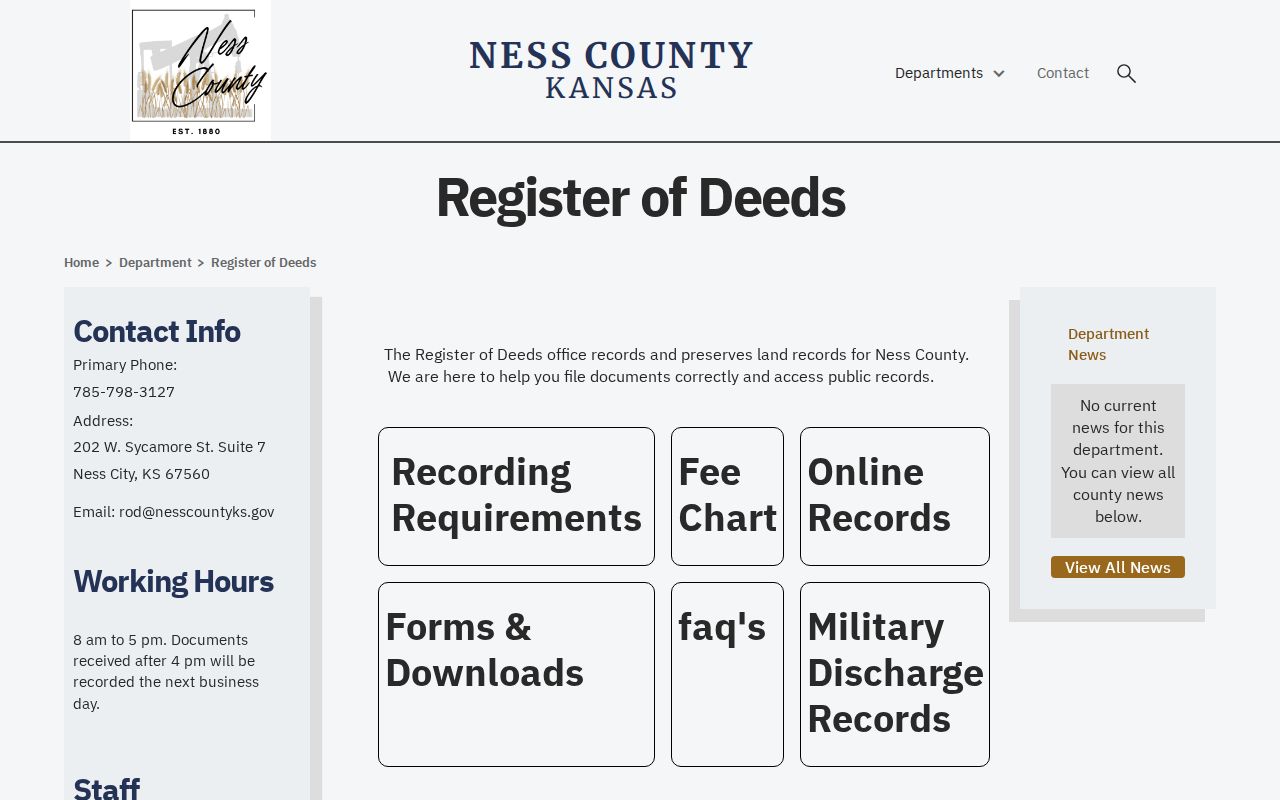
The county's own source anchors every deed copy request. Confirm current costs and record availability directly with the office.
Recorded, not guaranteed. Ness County deed records show accepted instruments, not a title opinion; unrecorded rights and defects can still require professional review.